In Spring ISD, you don’t have to look very far to find graduates who have benefitted from the district’s Career and Technical Education (CTE) programs, industry-based certifications, and advanced dual-credit college coursework.
You also don’t have to look far to identify students and graduates who have been impacted by the district’s partnership with Rice University’s Kinder Institute for Urban Research and its Houston Education Research Consortium. In fact, you only have to look as far as Spring ISD’s own technology department, where Michael King II – or Mike, as he’s known by those throughout the district who admire his positive attitude and technical savvy – currently works as an A/V technician.

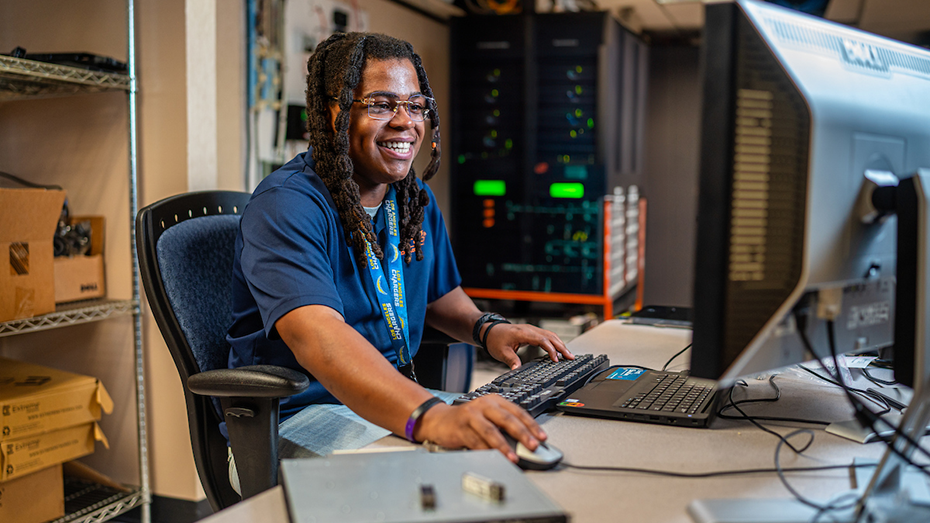
Spring ISD graduate and A/V technician Mike King.
For many who know him and his story, King serves as a prime example of what’s possible when talent and dedication meet opportunity and choice in the lives of Spring ISD students.
A Class of 2018 graduate who attended Spring ISD schools and spent most of his high school years at Carl Wunsche Sr. High School, King wasn’t always sure he wanted to go into technology. At one point, frustrated by a sophomore class in computer programming, he briefly switched his career path to dentistry in protest. But his counselor, together with Wunsche CTE teacher Lisa Evans, helped King see that the field of technology was bigger than he’d imagined.
“It was a computer maintenance class, I’ll never forget that, basically learning about the essentials of the hardware and different components of the computer,” King said. “Ms. Evans was really instrumental to me that year, I remember. It changed my whole outlook on how I viewed technology.”
Evans also made sure her students got hands-on experience – working on computer repairs both at Wunsche’s student help desk and through internship opportunities at Lone Star College. She also made sure her students took the steps necessary to begin completing relevant industry-based certifications – a proactive approach that saves students both time and money after graduation.
“Spring has really built me up,” King said. “I thank Spring ISD, because they really did give me the opportunity, and they gave me the chance to show what I could do.”
A partnership for growth
In recent years, Spring ISD and other area districts have been expanding those kinds of CTE offerings in order to serve students better across a range of career pathways and programs of study. The developments are a response, in part, to the insights gained through the district’s partnership with the Houston Education Research Consortium (HERC) and the Kinder Institute.
The district formally entered the consortium in 2017, when HERC researchers expanded their data-collection focus from Houston ISD in order to examine trends across the entire region.
Serving over 34,000 prekindergarten through 12th grade students in a diverse district 20 miles north of central Houston, Spring ISD has seen changes over recent decades – including changing demographics, a more diverse and international student body, and a shift from a more rural and suburban district to a more urban one as Houston’s growth has pushed the effective boundaries of the metro area farther and farther out.
Whether or not they’re always directly aware of it, recent district alumni like King are reaping the benefits of Spring ISD’s partnership with one of the Houston area’s most trusted sources of data and data analysis – the Kinder Institute and Rice University.
Spring is currently one of 10 area districts that share data with HERC’s team of doctoral-level researchers. The consortium’s main goal – according to Associate Director of Regional Research Dr. Lizzy Cashiola – is to apply research and data analysis in near-real-time and at a regional scale, generating actionable data to help close achievement gaps and address the complex needs of area students, schools, families, and employers.
“The ultimate goal is improving outcomes for students, improving equity and access to opportunities,” Cashiola said, “having that shared goal, and using research as a tool to reach that goal.”
HERC produces cutting-edge in-depth research and connects area districts with valuable insights that help them understand trends related to education and the job market, along with topics such as equity, student mobility and postsecondary readiness, all while tapping into the Kinder Institute’s ability to amass data from across the wider region.
It’s a winning proposition for participating districts, said Spring ISD Chief of Innovation & Student Success Dr. Matthew Pariseau.
“We can make great change when it’s led by data,” Pariseau said. “As educators, we’re deeply invested in our students, and we can ‘feel’ a lot of things, but the data shows the reality. When it’s interpreted carefully, it doesn’t lie, and it can help point the way forward.”
Pariseau said entering the HERC partnership and taking part in the ongoing research, briefings, and workshops with other participating districts had been a real benefit, helping district leaders gain a broader perspective and understand the implications of data and trends originally observed at the local level.
“Through all the developments of recent years, they’ve helped us navigate the changing landscape as we seek to innovate and develop programs that best serve the workforce of tomorrow,” Pariseau said.
A partnership for progress
In recent years, HERC research published by the Kinder Institute on student mobility helped Spring ISD and neighboring districts address the issue of students who may move several times over the course of a school year – both within and between school districts – interrupting their learning and often forcing teachers to do catch-up work to keep students on track.
“That mobility study helped us really see those gaps, where students were coming to and from, and the need even to have some curriculum collaboration with other districts around us,” Pariseau said. “We have a lot of students that travel back and forth. We saw the gaps within our own data sets from that movement, but the HERC partnership gave us the bigger picture.”
Having the study results through HERC helped support Spring ISD’s decision to adopt an aligned curriculum, one that wouldn’t penalize students just because their families move mid-year. Pariseau said the HERC research team’s skill in presenting the data also helped campus principals and teachers see the need for the shift and how it would serve students.
Other topics addressed through the partnership with HERC have involved Pre-K, student attendance and enrollment trends, and the benefits of dual-credit coursework opportunities for students. One of the consortium’s areas of study in recent years has been around outcomes for CTE graduates, like Spring ISD’s own King.
“The landscape of what CTE is has changed,” Cashiola said. “It’s not just your vocational prep of 10 to 15 years ago. It’s really setting students up for immediately joining the workforce and/or continuing towards a postsecondary credential in an aligned industry.”
A partnership for students
In extensive research published last fall, HERC reviewed the benefits of CTE pathway completion for college, career and military readiness (CCMR) – including higher initial earnings when first entering the job market – while also noting challenges many CTE graduates face. Those challenges include trying to complete postsecondary degrees and career certifications while balancing work, family life and other responsibilities after graduating high school.
According to Pariseau, these insights have only bolstered Spring ISD’s commitment to expanding access to dual-credit classes – which are now available to every Spring ISD high school student – as well as supplying more opportunities for students to complete internships and career-related training, and to earn as many industry-based certifications as possible while still enrolled with the district.
“That’s something that we’ve been working on in Spring, and we’ve had huge growth in that over the last five or six years,” Pariseau said. “We saw that graduates would go through and get the endorsement, but then they weren’t completing the certifications. Now our numbers are much higher, with 70% of our students having at least one industry-based certification by the time they graduate. Also, in all of our high schools, students now have the opportunity for dual credit and an associate degree. And that’s not something that was true here 10 years ago.”
While still a student at Wunsche, King was able to complete basic certifications that helped him hit the ground running as an intern and later as an employee in the district’s technology department. Now that he’s a few years into his career and has several roles under his belt – including working at the help desk, as an A/V technician, and as a campus technology specialist – King has seen the power of certifications, and has his sights set on continued learning.
“Within the IT field, it’s nice to have degrees, but the real weight is with your certifications,” King said. “You need the skills and the certs. I would one day like to be a part of our infrastructure team, so right now I’m studying to get my Network+ certification.”
Cashiola emphasized that HERC and the Kinder Institute are invested for the long term in conducting the kind of research that ensures students – like King and those who follow him – get access to everything they need to achieve long-term success after graduation. She also said that HERC couldn’t do what it does without the support and partnership of local districts that have access to real-time data and valuable insights of their own about the challenges that educators and students are facing today.
“Data and research tend to lag behind what’s actually happening in schools, and so that’s a challenge,” Cashiola explained.
“I would absolutely commend Spring ISD for engaging with us in this partnership as thoroughly as they do,” she continued, “because it takes time, effort and many other things to engage in a research study from the beginning all the way to the end. And then they’re the ones that take the information and use it to inform their decisions, so they’re the ones that are doing the hard work to benefit from the partnership.”
A partnership for the future
At just 24 years old and coming up on five years with the district’s technology team, King has racked up a number of impressive achievements in his young life. When asked about his proudest accomplishments, however, he looks back to his early childhood in San Diego, where his father was stationed in the U.S. Navy, and where King overcame one of life’s biggest obstacles.
“I was diagnosed with a germ cell tumor on my right kidney when I was 18 months old, and had to take chemotherapy,” King said. “They said I wouldn’t live till I was five. The way I see it, I was having to fight before I even knew what fighting was. So that’s kind of my ‘why.’ I could’ve not been here. I wasn’t supposed to be here, right? But I am, and what’s even better is I’m making a difference. I’m helping people out, and I guess that’s why I just love this job.”
After beating cancer as a child in San Diego, King said he’s always had a soft spot for the San Diego – now Los Angeles – Chargers football team, and he invoked the Chargers’ newly named coach Jim Harbaugh in explaining what drives him day in and day out in his work in Spring ISD.
“Honestly, it’s not the technology, it’s the people, the people I work with and what they do,” King said. “The fact that we’re contributing to a better tomorrow – a better future – with the youth, I just feel like, as my head football coach for the Chargers says, ‘Who’s got it better than us? Nobody!’
“I really believe that, just being able to pour into students’ lives and have a positive impact, and to know that I’m a part of that as well,” King added, “just seeing what these students are doing and just knowing that you play some part in that, it’s so rewarding.”
Educators and education researchers – like those in Spring ISD and at the Kinder Institute – know that leveling the playing field for Houston-area students is only a necessary starting point. Ultimately the goal is to empower students and graduates, like King, to carry the torch forward, to discover and develop their own strengths, and to dream of what contributions they might make in the service of others, no matter where they come from or what they’ve had to overcome in life.
“That’s why we do what we do,” Pariseau said.
You must be logged in to post a comment.