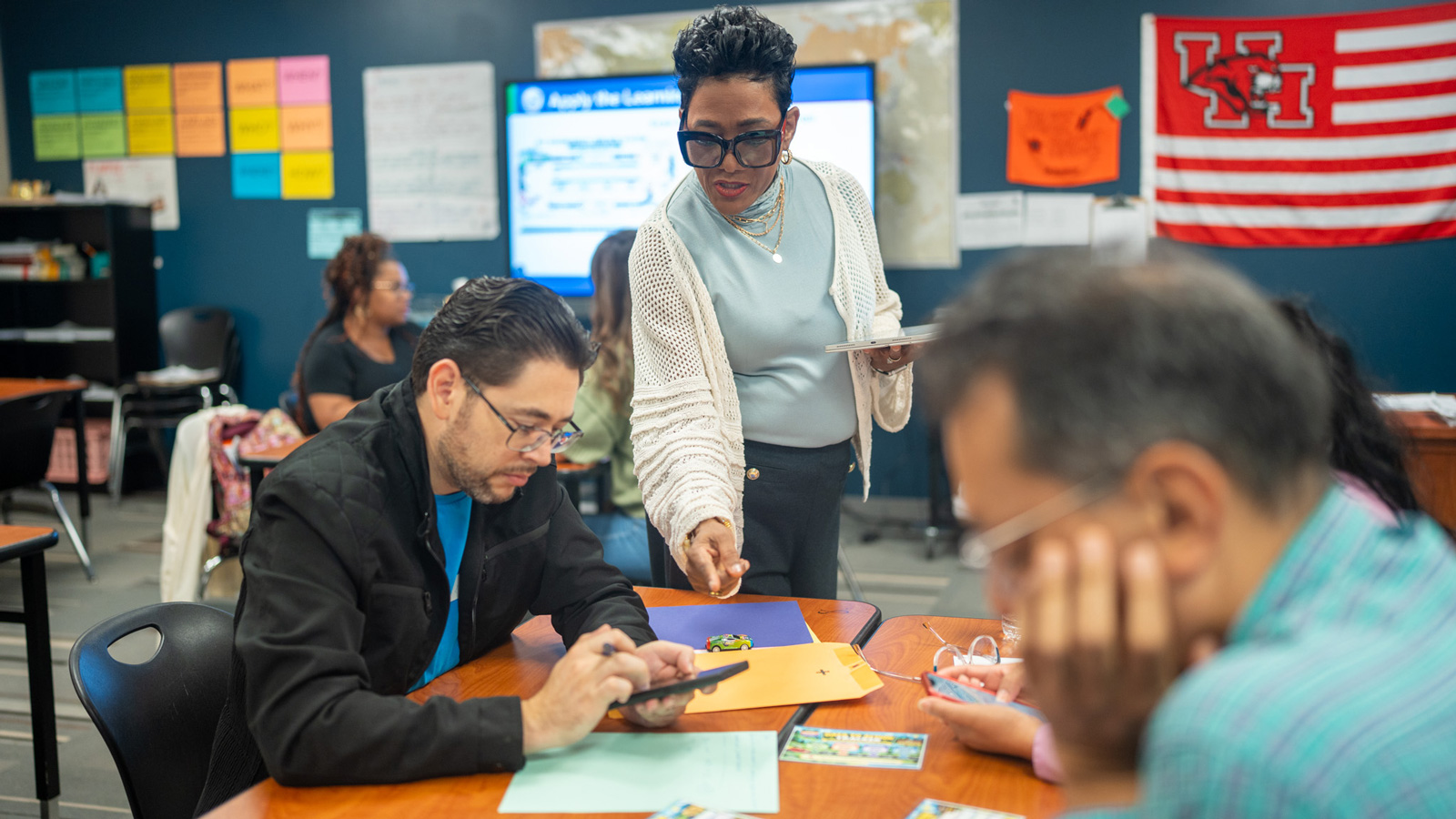
From innovative teaching strategies to hands-on learning experiences, nearly 500 Spring ISD educators came together on Oct. 24 at Carl Wunsche Sr. High School for the district’s Fall Learning Fair, a day dedicated to strengthening classroom instruction, sharing ideas and creating new opportunities for student success.
The event featured 100 professional learning sessions, offering opportunities to learn from district specialists, instructional leaders and fellow teachers. Topics ranged from lesson planning and student progress monitoring to multilingual instruction, special education and strategies for engaging students through movement.
For Robyn Carrier, Spring ISD’s Secondary Executive Director of Curriculum, Instruction and Professional Learning, the event highlighted the importance of collaboration and continuous professional growth in strengthening classroom instruction.
“This not only gives them the opportunity to collaborate with other teachers from different campuses across the district, but it gives them additional tools in their tool belt,” Carrier said.
That emphasis on collaboration extended to district leadership, with Chief Learning Officer Dr. Alisa Zapata recognizing the importance of giving educators dedicated time to learn from one another and explore new instructional strategies.
“This is just such a great time for everyone to come together in learning sessions where they actually have the time to learn on a Saturday without the hustle and bustle,” Zapata said. “I hope that everyone will walk away with something new.”
That opportunity to learn took shape throughout the day as presenters wasted no time immersing teachers in each of their lessons. From aggressive monitoring and lesson internalization to techniques for checking student understanding, the sessions focused on helping teachers identify learning gaps, adjust instruction in real time and better meet students’ individual needs.
Among those leading the sessions was Dr. Jennifer Bassett-Alvarez, Director of Early Childhood and Primary Curriculum, Instruction and Professional Learning, who highlighted the opportunity for teachers to select sessions tailored to their professional development needs and gain practical tools to use throughout the school year.
“Our teachers can’t grow unless someone else is pouring into them,” Bassett-Alvarez said, emphasizing the importance of district specialists and other leaders investing in the professional growth of educators.
For participants like second-grade bilingual teacher Enma Pereira of Major Elementary School, the benefits extended beyond learning new instructional techniques. She was able to explore new platforms that she can incorporate into her instruction to help prepare students for the next grade level.
“Professional development helps teachers feel more confident in their instruction in order to do a better job,” Pereira said. “When a teacher knows what they are doing, they can connect easier with the kids.”
Also in attendance was Isabel Funes, a 10th-grade geometry teacher at Westfield High School, who took advantage of the Learning Fair to exchange ideas with colleagues, clarify questions and explore strategies to make instructional planning more efficient.
“In this session, I learned how to internalize in order to use time more efficiently in class and also how to manage my own time as a teacher,” Funes said. “Students engage better when a teacher is prepared.” In lesson internalization, educators learned to anticipate challenges and plan targeted questions and instructional responses.
Other sessions introduced creative approaches to student engagement, including the use of physical movement to reinforce academic concepts.
Sarah Ford, a fourth- and fifth-grade science teacher at Jenkins Elementary School, was among the presenters who led “It’s Magic: Movement for Academic Growth in Classrooms.”
“I love what this does for our students and the joy it can bring into a classroom,” Ford said. “And I love networking with the teachers, we are able to talk and share ideas. We’re better together in culture.”
Another session, led by Cory Neblett, Spring ISD’s Secondary RTI/MTSS Coordinator, focused on aggressive monitoring, an instructional strategy that helps teachers identify learning gaps by reviewing student work, recognizing misconceptions and providing immediate feedback or additional instruction.
“It gives the teachers an opportunity to correct some misconceptions that may have been learned during the first nine weeks of school,” he said. “Here, they have an opportunity to get it right.”
As the Learning Fair concluded, the focus shifted to bringing those strategies back into classrooms. For Carrier, the hope is that educators leave with renewed enthusiasm and practical tools they can use throughout the school year.
“I hope that our educators take away a renewed, fresh spirit,” Carrier said. “I hope that the strategies, skills, and tools we’re providing them with will give them what they need to support our students.”